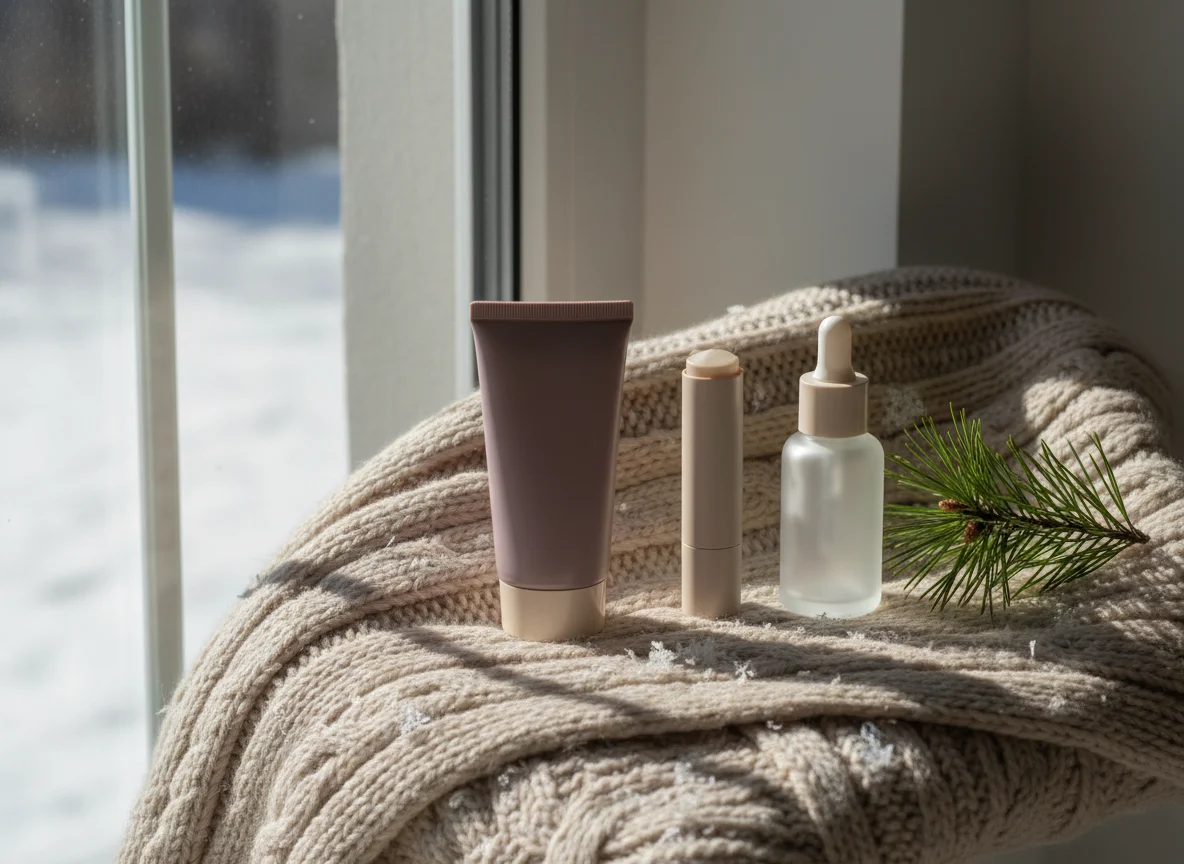
Grey skies, short days and a scarf pulled up to your nose: it is easy to think sunscreen can go back in the drawer until May. But do you need SPF in winter? For most people across Europe, the honest answer is yes, at least on your face and hands. The sun is lower and weaker in the cold months, but it has not gone away, and some winter situations (snow, altitude, long walks on bright frosty days) actually raise your exposure. Here is what changes in winter, when daily protection matters most, and how to fit it into a richer cold-weather routine.
Why SPF in winter still matters
Sunlight reaches us as two main types of ultraviolet light. UVB is the one that causes sunburn, and it really does drop in winter, especially in northern Europe. UVA is different. It stays far more constant through the year, passes through cloud and ordinary window glass, and is closely linked to the slow, visible signs of sun exposure such as uneven tone, dark spots and a loss of firmness over time.
So while a December commute in Amsterdam or Dublin is unlikely to leave you pink, the daily, low-level UVA dose adds up across the seasons.
Clouds, windows and short days
Thin or broken cloud lets a large share of UV through, which is why people still burn on overcast days. Sitting by a sunny office or car window also counts, because glass blocks most UVB but much less UVA.
Winter sunscreen for snow, ski trips and mountains
This is where winter sun protection becomes essential rather than optional. Fresh snow reflects a large part of the UV that hits it back up towards you, so you are exposed from above and below at the same time. UV also rises with altitude, roughly by about 10% for every 1,000 metres, and the air in the Alps, Pyrenees or Dolomites is thinner and often very clear. Add wind and cold, and skin on a ski slope can burn and dry out surprisingly fast.
For ski skincare, think high protection and easy reapplication:
- Use a broad-spectrum, high-SPF product on your face, ears and neck before you leave the chalet.
- Carry a stick in your jacket pocket. Our Sun Protection SPF50 Stick fits in a ski jacket and goes on without bare, cold fingers dipping into a tube.
- Reapply every two hours, and sooner after sweating, wiping your face or a long lift ride in strong sun.
- Do not forget the tip of your nose, cheekbones, under the chin and the tops of your ears, which catch reflected light from the snow.
Choosing your winter SPF
The best SPF is the one you will actually wear every morning. In winter, texture matters more than usual, because cold air and central heating leave many people with tight, dry skin. If you want to understand the difference between filter types before choosing, our guide to mineral vs chemical sunscreen explains it in detail.
| Situation | Good choice | Why it works in winter |
|---|---|---|
| Daily city commute | Sunscreen SPF30 with tint | Evens out a tired winter complexion, so it can replace a light base |
| Weekend walks, face and body | Mineral Sunscreen SPF30 Face & Body | One bottle for face, neck and hands, handy for families |
| Skiing, snowshoeing, high altitude | Sun Protection SPF50 Stick | High protection, pocket sized, quick to reapply on the slope |
A simple winter morning routine with SPF
Sunscreen works best as the final step of your morning skincare. In winter, the layers underneath should focus on comfort and moisture, so the SPF sits on well-cushioned skin.
- Cleanse gently. Use lukewarm water rather than hot, which can leave skin feeling stripped in cold weather.
- Antioxidant serum. A few drops of Vitamin C Serum (with vitamin C and ferulic acid) pairs well with daytime SPF for brighter-looking skin.
- Hydration. Press in Hydrating Serum with hyaluronic acid while skin is still slightly damp.
- Moisturise richly. On very cold or windy days, Nourishing Rich Cream, Fragrance Free gives dry skin a comforting layer. Let it settle for a minute or two.
- Apply SPF last. Use about two finger-lengths for face and neck, and do not forget the backs of your hands.
For more on keeping skin comfortable through the season, see our full winter skincare routine.
Do not forget your hands
Hands are often the most exposed part of the body in winter. Smooth a little SPF over the backs of your hands in the morning, then use a hand cream such as Silk Skin Hand Cream, Spices & Sandalwood in the evening once you are indoors.
Common winter SPF mistakes
- Relying on make-up alone. Foundation with SPF is rarely applied thickly enough to give the protection on the label. Use a dedicated sunscreen underneath or a tinted SPF instead.
- Applying once and forgetting. For a normal office day one morning layer is usually enough, but outdoor days, and especially snow days, need reapplication.
- Ignoring changes in your skin. If you notice a mole or patch that changes, bleeds or will not heal, see a doctor or pharmacist rather than treating it yourself.
Frequently asked questions
Do I need SPF in winter if I work indoors all day?
If you sit near a window or go outside at lunchtime, a light daily SPF is still a good habit, because UVA passes through glass and cloud.
What SPF should I use for skiing?
Choose a broad-spectrum SPF50 for the slopes, because snow reflection and altitude both raise UV levels. Reapply every two hours and after wiping your face. A stick format is the easiest to carry and use with cold hands.
Can I use a rich moisturiser and sunscreen together?
Yes. Apply your moisturiser first, give it a minute or two to settle, then apply sunscreen as the final layer.
Ready to protect your skin all winter? Explore our vegan, EU-made face care collection.